Many businesses receive useful help from their accountant on financial statements, tax and year-end matters. But the operational decisions that create those financial results happen long before year end: what to buy, when to buy it, what to receive, where stock is, what has been promised to customers, what has actually left the warehouse, what is slow moving, what needs replenishment, and whether the information in the system reflects physical reality.
TidyStock can provide a strong operational record, but software only delivers its full value when the business uses consistent workflows. This guide focuses on those workflows. It is not intended to replace your accountant, auditor or business adviser. Rather, it helps you run the operational side of the business well enough that the financial information they receive is more timely, reliable and useful.
The seven disciplines of a well-run stock business
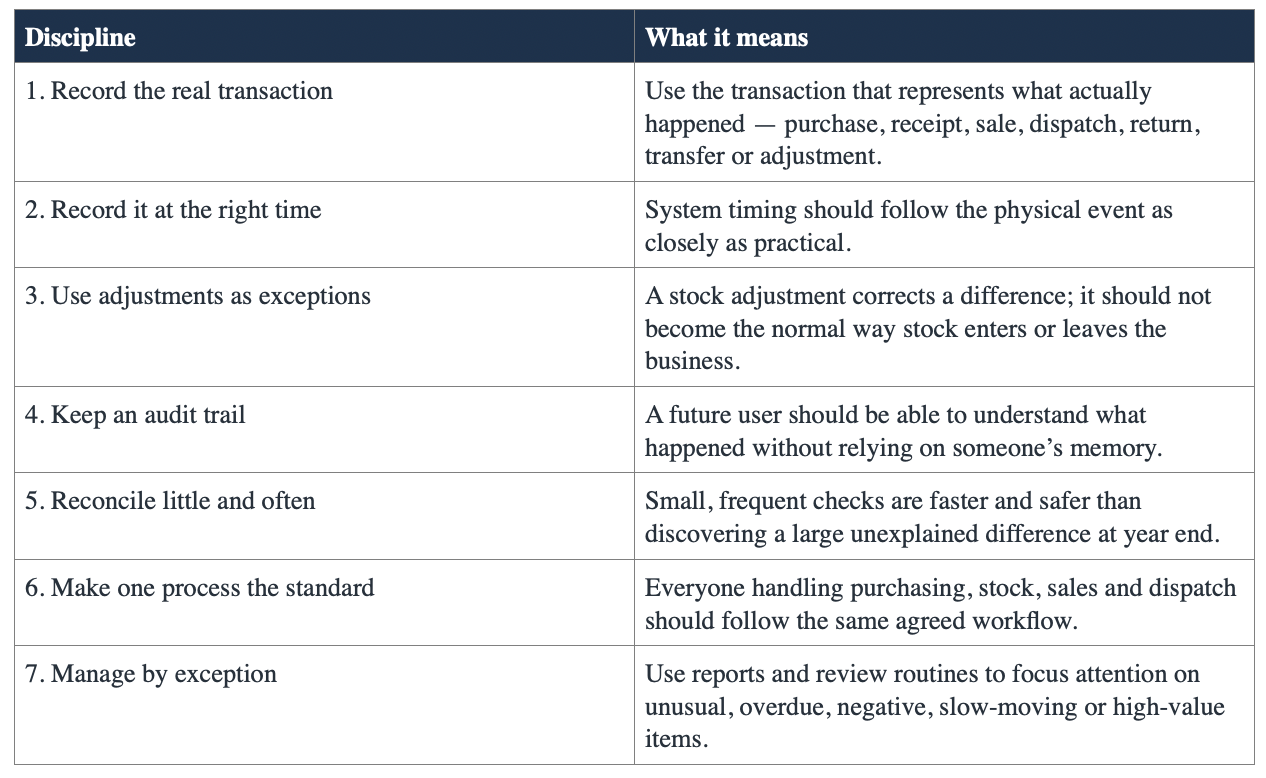
1. Build the transaction chain — don’t bypass it
The strongest stock record is created when each operational event is captured through its normal workflow. For incoming stock, that normally means purchasing and receiving rather than simply changing the quantity on hand.
Recommended purchasing flow
Avoid this anti-pattern
Do not routinely bring purchased stock into TidyStock using manual stock adjustments. That may make the on-hand number look right, but it removes purchasing context and makes it harder to understand supplier commitments, receipts and the history behind the quantity.
Recommended sales and dispatch flow
Your Tidy workflow should reflect the point at which goods physically leave your control. In the standard TidyStock workflow, stock movement is associated with dispatch. Make sure the operational status in Tidy matches what has actually happened in the warehouse.
Why timing matters
A sale date, invoice date and physical dispatch date can represent different events. If users assume they are interchangeable, stock history and stocktake reconciliation can become confusing.
2. Treat stock adjustments as controlled exceptions
Adjustments are necessary in every real stock business: damage, shrinkage, count corrections, samples, write-offs and occasional data corrections happen. The best-practice distinction is simple: an adjustment explains an exception; it should not replace the normal business transaction.
Every adjustment should answer four questions
Use clear references and descriptions. A future investigation should not have to interpret a vague note such as “stock fix”. For material or unusual adjustments, retain the supporting evidence according to your business’s record-keeping policy.
3. Make stocktakes a verification process, not a rescue operation
A stocktake is most valuable when it verifies a system that is already being kept accurate. If the business relies on a year-end count to repair months of weak transaction discipline, the count becomes slower, more stressful and harder to reconcile.
Best-practice stocktake sequence
Important date discipline
Do not backdate a later physical count merely to make it represent an earlier year-end position. If a physical count occurs after year end, use the actual count date and reconcile the intervening stock movements. For year-end accounting treatment, confirm the final reconciliation with your accountant or auditor.
Cycle counting: reduce the year-end burden
Consider counting selected stock throughout the year rather than waiting for one annual event. High-value, high-volume or historically problematic items can be checked more often. This turns stock accuracy into an operating rhythm and helps reveal process problems early.
4. Protect the quality of your master data
Transaction discipline depends on clean master data. Duplicate items, inconsistent descriptions, incorrect units, obsolete supplier records or uncontrolled customer-specific pricing create avoidable ambiguity.
5. Give each operational event an owner
A process is only reliable when someone is responsible for completing it. “The system is wrong” often begins with an event that happened physically but was never completed digitally, or was completed differently by two people.

6. Use a simple management rhythm
The purpose of TidyStock is not simply to store transactions. It should help management see what needs attention. A short, regular operating rhythm is more useful than a large review after problems have accumulated.
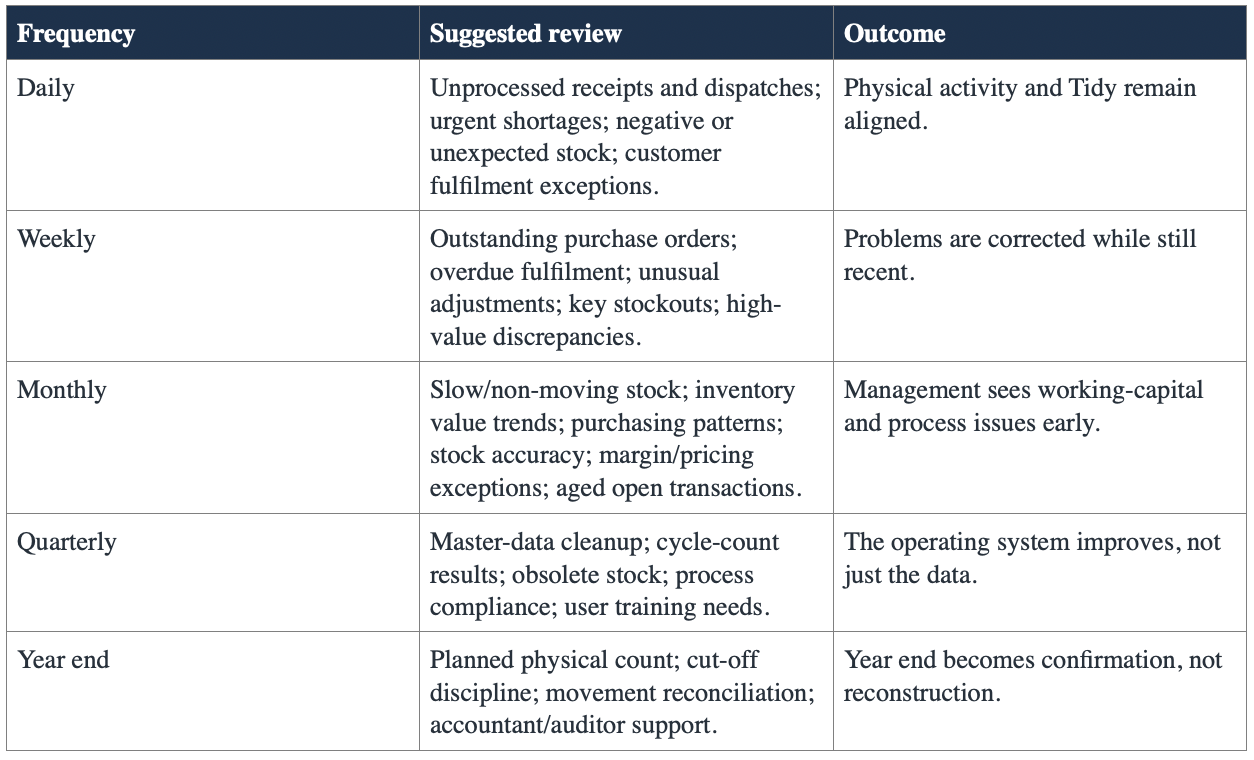
Questions managers should ask
7. Understand how daily operations create the year-end result
Inventory affects cash, customer service, purchasing, gross margin and the reliability of financial reporting. The operational team therefore influences year-end performance every day.

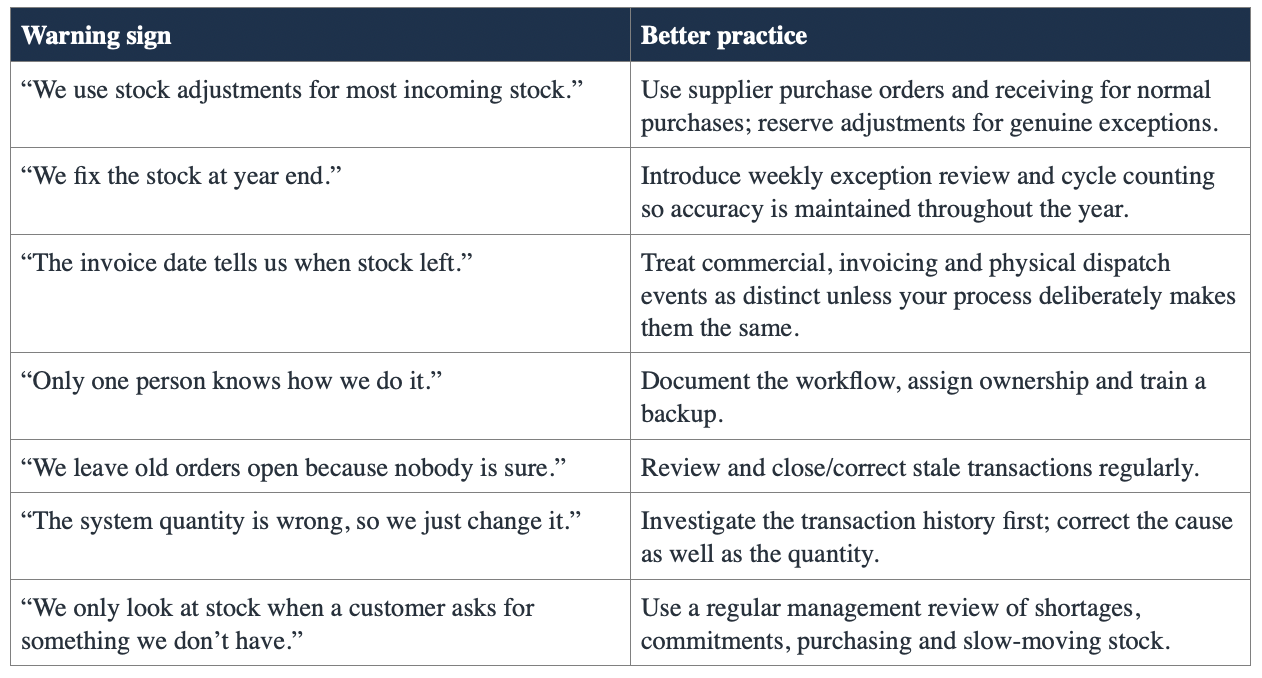
8. Common warning signs — and what to do instead
9. A 30-day TidyStock improvement plan
You do not need to redesign the business in one project. Start with the transaction chain and build discipline from there.
Week 1: Map reality — Write down how purchasing, receiving, sales, dispatch, returns, adjustments and stocktakes actually happen today. Identify where physical events and Tidy entries diverge.
Week 2: Fix the core workflow — Agree one standard process for purchases/receipts and one for sales/dispatch. Stop using adjustments as a substitute for normal transactions. Clarify roles.
Week 3: Clean and reconcile — Review stale open transactions, obvious master-data issues and unusual adjustments. Begin targeted physical checks of important items.
Week 4: Install the rhythm — Introduce the daily/weekly/monthly review cadence. Record recurring exceptions and decide whether the answer is training, process change, data cleanup or a product/workflow discussion with Tidy.
Success after 30 days
The goal is not zero differences. The goal is that differences are unusual, explainable and acted on — and that the normal flow of goods is represented by the normal flow of transactions in TidyStock.
10. Best-practice self-assessment
Score each statement: 0 = not consistently true, 1 = partly true, 2 = consistently true.
☐ 0 ☐ 1 ☐ 2 Normal supplier purchases are created and received through purchase orders.
☐ 0 ☐ 1 ☐ 2 Physical receipts are entered promptly and accurately.
☐ 0 ☐ 1 ☐ 2 Physical dispatches are reflected promptly in the agreed TidyStock workflow.
☐ 0 ☐ 1 ☐ 2 Manual stock adjustments are exceptions and have meaningful reasons/references.
☐ 0 ☐ 1 ☐ 2 Stocktake entries use the actual physical count date.
☐ 0 ☐ 1 ☐ 2 Significant stock differences are investigated rather than simply overwritten.
☐ 0 ☐ 1 ☐ 2 Outstanding purchase orders are reviewed regularly.
☐ 0 ☐ 1 ☐ 2 Open customer orders are reviewed regularly.
☐ 0 ☐ 1 ☐ 2 Master data and customer/supplier pricing are kept orderly and duplicates are controlled.
☐ 0 ☐ 1 ☐ 2 High-value/high-risk items are cycle-counted during the year.
☐ 0 ☐ 1 ☐ 2 Management reviews stock exceptions at least weekly.
☐ 0 ☐ 1 ☐ 2 At least two people understand the core stock workflows.
☐ 0 ☐ 1 ☐ 2 Year-end stock information can be reconciled from operational records without reconstructing months of activity.
Indicative interpretation: 21–26 = strong discipline; 14–20 = useful improvement opportunities; 0–13 = prioritise core workflow and reconciliation before adding complexity.
The operating principle to remember
Good year ends are built during the year
TidyStock is most valuable when it becomes the operational record of the business — not a database that is corrected after the event. Record real transactions, at the right time, through the right workflow. Reconcile frequently. Investigate exceptions. Then use the information to make better purchasing, fulfilment and stock decisions.
When to ask Tidy for help
Contact Tidy when your real business workflow does not fit the standard TidyStock process, when you are unsure which workflow should be used, or when repeated exceptions suggest that configuration, training or product capability should be reviewed. It is better to agree the correct process before a workaround becomes embedded.
Related Tidy Academy learning
Tidy Academy note: specific screens, settings and available capabilities may evolve. Use the current product help for detailed click-by-click instructions. This guide is intended to explain the management principles and operating disciplines that sit behind those instructions.
